

Will vs. Trust: What’s the Best Plan for Your Family?
Thinking about the future and how to protect your family is one of the most important things you can do. When it comes to planning your estate—that is, deciding who gets your property after you’re gone—two tools are most common: a will and a trust. They both help you achieve your goals, but they work in very different ways. Let’s break them down in simple terms.

What is a Will?
Think of a will as an instruction letter you leave for your family and a judge. It’s a legal document that only comes into effect after you pass away. In it, you can name:
- Who gets your property? These people are your beneficiaries.
- Who is in charge of carrying out your wishes? This person is your executor.
- Who will care for your young children? This person is their guardian.
A will is straightforward. However, for a will to be put into action, it almost always has to go through a court process called probate. During probate, a judge confirms the will is valid and oversees your executor as they pay your debts and distribute your property. This process can take a long time—sometimes more than a year—and it is public. This means anyone can look up your will and see what you owned and who you left it to. It can also be expensive to probate a will.
What is a Trust?
A trust is more like a special box you create to hold your property for the benefit of others. You can put your house, bank accounts, and investments into this box. A trust is managed by someone called a trustee. While you are alive and well, you can be your own trustee.
The biggest advantage of a trust is that it helps your family avoid probate. Because the property is owned by the trust, not by you personally, there is no need for a court to get involved after you pass away. Your chosen successor trustee simply steps in and distributes the property to your beneficiaries according to the rules you set in the trust document. This process is completely private and usually much faster than probate.
A trust also works if you become unable to manage your own affairs. If you get sick or injured, your successor trustee can manage your property for you, helping pay your bills and take care of you without needing to go to court to have you declared incompetent.
For more resources on estate planning, visit the American Bar’s website.
Key Differences at a Glance
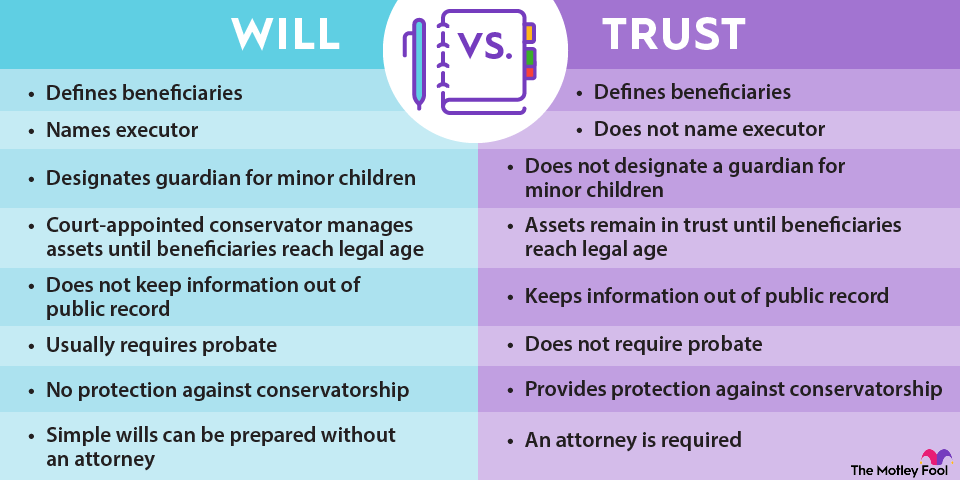
Image source: The Motley Fool
| Feature | Will | Trust |
|---|---|---|
| Probate? | Yes, usually. | No, it avoids probate. |
| Privacy? | No, it becomes a public court record. | Yes, it is a private document. |
| When it Works? | Only after you die. | Works while you’re alive and after you die. |
| Cost? | Cheaper to set up initially. | Costs more to create and set up. |
| Control? | Less control over how assets are used. | More control (e.g., you can specify that a child gets money at a certain age). |
The Takeaway: Which One is Right for You?
So, should you get a will or a trust? The answer depends on your goals.
If you have a smaller estate and your main goal is simply to name a guardian for your children, a will might be enough.
If you own a home or have significant assets, and you want to spare your family the time, cost, and public nature of probate, a trust is often the better choice. Many people who set up a trust also have a simple “pour-over” will. This acts as a safety net to catch any property you forgot to put in your trust and directs it there after you pass.
Planning for the future is a gift to your loved ones. Understanding these basic tools is the first step toward creating a plan that provides peace of mind for you and security for them.
Ready to Plan for Your Estate?
Planning your estate is a profound act of care, but you don’t have to navigate the complexities alone. Contact the experienced team at LawPoint today to schedule a consultation and take the first step toward securing your family’s future. Attorney Kristina Retzlaff has years of experience and will help you decide what is best for your family.
Recent Comments